Showing posts with label soldier. Show all posts

Monday, February 24, 2014

"I Have a War to Finish" - The Legacy of Leo Major


One of the most celebrated Canadian soldiers, Leo Major served in World War II as well as the Korean War. His actions earned the Distinguished Conduct Medal, a prestigious award only two other Canadians have received yet he has achieved this honor twice. Born in Massachusetts on January 23, 1921, his family soon relocated to Montreal, Canada. Suffering a tempestuous relationship with his father, Leo ran away from home to live with his aunt. Once he completed high school, the lack of career opportunities prompted him to enlist in the Canadian army. He was placed in the Regiment de la Chaudiere, sent to Scotland to train as a sniper and was selected as a member of the elite squadrons to engage D-Day operations.
Leo writing a letter after being hospitalized
Landing on Normandy, he survived the dash across the beaches and single-handedly captured a German Armored Vehicle that conveniently contained German Army codes. During a melee with an SS Patrol, he managed to kill several soldiers before one launched a phosphorous grenade at him. The blast caused him to lose vision in an eye. Although medical doctors prepared to evacuate him to England, he defiantly refused by stating, “No way! Sorry, but I have a war to finish.”
           He now wore an eye patch over his left eye, chuckling that he appeared like a pirate. Instead of wallowing over his loss, he cheerfully stated that he only required one eye to serve his country. The man’s steeled resolve allowed his skill to flourish despite his marred vision and after healing sufficiently, he resumed combat. Shortly following the summer of 1944, forces clashed in the Battle of Scheldt, wherein Leo captured ninety three German soldiers in Holland. Scouting the location of a missing Canadian infantry unit during a reconnaissance mission, Leo came across his captured compatriots. Swiftly he ambushed two German troops with the intent to make them his prisoners. Successfully doing so, a nearby garrison witnessed the activity. Believing their commander had surrendered, they followed suit, allowing Leo to march roughly one hundred prisoners back into the Allied camp.

A video homage to the French-Canadian war hero

February 1945 rumbled through as did the Padre. Leo assisted by loading corpses from a destroyed Tiger Tank onto the vehicle, and as just as the driver ignited the engine, the carrier struck a tank mine. Leo’s body collided with the ground, causing him to instantly black-out. He was loaded onto a stretcher, driven thirty miles away to a field hospital and yet again instructed to return home. The doctor’s report revealed that three portions of his back were broken along with four ribs and both ankles. Not daunted in the slightest, Major devised an escape route during his week-long recovery. He hitched a ride onto a jeep which drove him to Nijmegen where he stayed with a family for a month before returning to his regiment in March. Precisely during this time, his unit approached Zwolle, a resisting Belgian city enduring German occupation. Volunteering along with his close friend Willy Arseneault, the men desired to contact the Dutch Resistance and overrun the city despite the fact that their orders were to only calculate the amount of Germans stationed within Zwolle. Accidentally giving his position away, Willy was gunned down by machine fire which sent Leo into a rage. Major slung Arsenault’s weapon and his own rifle onto his back, grabbed a German machine gun from the now-dead sentry who had shot Willy then crept into town under the cover of darkness.
Willy & Leo
Major’s strategy resembled maniacal flailing as he ran through the city ambushing troops. He consistently captured German soldiers, a reported ten times throughout the night, then escorted them to the Canadian troops positioned along the city’s periphery before heading back to satisfy his grief. His vicious attack convinced the Nazi troops that a grand force had infiltrated the city, whereas it was merely a single man wielding three machine guns and a sack of grenades who sprinted throughout the city shrieking and firing at any visible Axis soldier. One of the most notable events of his killing spree was when he found his way into an SS club and managed to kill four high-ranking officers before burning down the Gestapo’s headquarters. Before the sun rose, the entire German force had evacuated the city and returned control to the Dutch. At 5:00 am, Leo arrived back at camp after collecting the remains of his friend. Alone and exhausted, Leo served as Zwolle’s liberator.
DCM Award Ceremony
This victory heralded his first DCM. However, he rejected the award, believing his commander, General Bernard Montgomery, was incompetent and unqualified to award such a medal - a bold claim issued from a lowly private to the Canadians' Allied High Commander. Although he did not accept the award, he is credited for his service and soon gleaned another DCM for his service in the Korean War where he captured and held Hill 355 against the 64th Chinese Army which had driven the Third US Infantry off the slope.

          Leo had quietly resumed civilian life but returned to war when Canadian commander Dextrase asked him to serve as his Corporal in 1951. By this point, the Americans appeared surrounded. Fortunately, Leo Major’s sniper division crept up and recaptured the hill. Success was not easily won for the Canadian force bravely mustered a three day counter-assault until reinforcements arrived although Leo had been ordered to retreat. According to General Dextrase, Leo ought to have received at least eleven DCM’s for his actions in WWII alone for he viewed the one-man army as the epitome of the Allied soldier.
Zwolle celebrating one of Leo's visits
Concluding the war, Leo returned to Montreal and lived with his family until his death in 2008. He made numerous trips to the Netherlands and was further honored by being dubbed an honorary citizen of Zwolle. Leo continues to be revered by the citizens of Zwolle and his fellow Canadians who feature his exploits in their educational curriculum. His fearless determination and devotion ought to be recognized and applauded for his selfless dedication to duty and liberty.

_____________________________________________________________

Suggested Reading:

Brown, George A. For Distinguished Conduct in the Field: The Register of the Distinguished Conduct Medal 1939-1992. Eastbourne: Antony Rowe Ltd, 2009. http://www.amazon.com/For-Distinguished-Conduct-Field-1939-1992/dp/1843423472/ref=sr_1_4?ie=UTF8&qid=1393269404&sr=8-4&keywords=Private Leo Major (accessed February 24, 2014).

Zuehlke, Mark. On to Victory: The Canadian Liberation of the Netherlands, March 23—May 5, 1945 (Canadian Battle). Vancouver: Douglas & McIntyre, August 2010. http://www.amazon.com/Victory-Canadian-Liberation-Netherlands-23—May-ebook/dp/B003Z9JMRK/ref=sr_1_2?ie=UTF8&qid=1393269404&sr=8-2&keywords=Private Leo Major (accessed February 24, 2014).

"Liberator of Zwolle: Léo Major, the forgotten hero." Canoe.ca. http://fr.canoe.ca/hommes/culture/archives/2014/02/20140217-172800.html (accessed February 24, 2014).

"Léo Major - War Hero." Youtube. http://www.youtube.com/watch?v=GIqPXR9n-OM (accessed February 24, 2014).

"Leo Major." The Hero Construction Company. http://www.theherocc.com/leo-major/ (accessed February 24, 2014).

"Divergent Portraits of War: If you saw him sitting in a hotel restaurant along the Stationweg in this old walled city, your gaze likely wouldn't linger." Canada. http://www.canada.com/ottawa/ottawacitizen/news/story.html?id=fbcc446c-231f-4781-940a-3ebc3dee9f94 (accessed February 24, 2014).

Fowler, T.R. "LÉO MAJOR, DCM and BAR." kvacanada. http://www.kvacanada.com/stories_trfLeo.htm (accessed February 24, 2014).

Monday, January 27, 2014

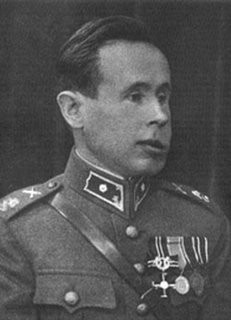
White Death: Simo Häyhä


        Deemed one of the greatest snipers of all time, Simo Häyhä represents the resilience of the Finns against their Soviet adversaries during the Winter War coinciding with World War II. Born in the small town of Rautajärvi in 1905, Simo tasted Soviet oppression at an early age due to the close proximity to the Russian border. Häyhä enjoyed the rugged landscape of rural Finland and swiftly developed as a farmer and skilled hunter known for his marksmanship. This solitary lifestyle enhanced his prowess with weaponry, an aptitude proven vital during the oncoming Winter War.
   
In 1925, a seventeen year old Häyhä joined the Finnish Army for a year of mandatory service and achieved the rank of corporal. Eventually Simo Häyhä joined the Suojelskunta (Finnish Civil Guard) similar to the National Guard of the United States prior to being entangled in the Winter War under the 6th Company’s banner. Simo responded to the aid of his country when the USSR invaded in November, three months after the eruption of WWII in 1939. While drifting through the tundra, Simo concealed himself by wearing white camouflage and refused to use a scope for he noted that the sun would reflect off the glass and give his position away. Another innovation he utilized was to put snow in his mouth in order to deny a foggy exhalation from escaping his lips. He took every precaution to avoid tipping off Russian counter-snipers of his location; soldiers bent on deposing their most feared adversary whom they dubbed “White Death.” Such a title was legitimized by his impressive five hundred and five head count. Using a Mosin-Nagant rifle which suited his short stature, Häyhä achieved the highest recorded number of confirmed sniper kills in any major war.
(An account of Simo Häyhä's background & military experience)

       A tactical professional, Simo’s credited with two hundred deaths by way of a sub-machine gun in addition to his aforementioned glory. During the most brutal days of the Winter War, Simo’s company secured the demise of Soviet expansion. Defending the Kollaa region was nothing short of a miracle as exposed by the massive loss the Soviet Army suffered at the hands of Finns refusing to comply with communist invaders. "The Miracle of Kollaa" proved to be the epitome of the Finnish chant “sisu” which translates to “guts” or “fortitude” in which the Simo’s 34th Regiment, nobly clashed against twelve Soviet divisions which equated 160,000 men as opposed to the single Finnish unit. Striking fear into the hearts of the advancing Red Army, Simo took solace in the closely shrouded timber while forced to deflect artillery units specifically deployed to exterminate their lone, elusive threat. Despite invisibly stalking Soviets in temperatures as low as –40 °C, a Russian soldier struck his mark on March 6, 1940. The bullet exploded into Häyhä’s jaw, blowing away half of his face and yet survived. Although successfully retrieved from the battlefield, Simo slipped into a coma until he regained consciousness March 13, the very day the war ended.
   
After his recovery, Simo advanced to the rank of second lieutenant, a rapid promotional feat nonexistent in the Finnish military. Offering a transfixing quote, Simo explained his regret by stating that “I only did my duty, and what I was told to do, as well as I could.” Permanently disfigured, the humble man soared as a national hero. In his later years, the outdoors man occupied his retirement by hunting moose, breeding dogs and responding to interviews related to his wartime exploits. Häyhä embodies the spirit of Finland; having played a pivotal role through which his accomplishments contributed to preserving Finnish sovereignty. The great sniper and Finnish warrior encapsulated the strength of a nation reflected by his valiant service and calm resolve.


___________________________________________________________________________

Suggested Reading:
"Simo Häyhä The White Death - World's Greatest Sniper." http://www.mosinnagant.net/finland/simohayha.asp (accessed January 27, 2014).

"The Incredible Story of Finnish Sniper Simo Hayha.” http://www.simohayha.com/ (accessed January 27, 2014).

“Finland at War, 1939-45 Volume 141 of Elite series” http://books.google.com/books?id=p58vtOKyVy8C (accessed January 27, 2014).

“Frozen Hell: The Russo-Finnish Winter War of 1939/40.” http://books.google.com/books?id=yXsLNVaDfcoC&lpg=PP1&dq=Trotter, William R. Frozen Hell: The Russo-Finnish Winter War of 1939/40.&pg=PP1 (accessed January 27, 2014)


“The Sniper Simo Hayha,” http://www.amazon.com/Sniper-Simo-Hayha-Tapio-Sarrelainen/dp/9525026744/ref=cm_cr_pr_pb_t (accessed January 27, 2014).