Showing posts with label military history. Show all posts

Tuesday, January 20, 2015

Eddie Rickenbacker: Ace of Aces


Known as “America’s Red Baron,” Edward Reichenbacher, the son of Swiss immigrants, grew up during the early 1900s in Columbus, Ohio. An aptitude for speed inclined Eddie to race in multiple Indianapolis 500s in which his skills swiftly vaulted the young man to third place among all American racers in 1916. Driving for different motor companies offered Rickenbacker a substantial income and a mechanical career which soon ignited a passion for the developing field of aviation.


Patriotic heart ablaze, Eddie immediately volunteered to join the armed forces upon the United States' decision to intervene in the international affairs of World War 1.
Innovative and resourceful, he petitioned to form a league of militarized racecar drivers, a unique alternative that was promptly refused. Despite the rejection of his idea, Eddie received a position as the personal driver for General John Pershing and other high-ranking officers. He was even called upon to repair the car of Army Air Service Chief, Billy Mitchell, who insisted on Rickenbacker attending aviation school in France which specialized in training US airmen prior to their deployment to the Western Front. However, he remained at Issoudun as an engineering officer who was permitted to fly outside of his duties yet forbidden from participating in the war. Growing restless with the arrangement, Eddie requested to join the most recent aerial division, the 94th Aero Squadron; a request which was granted.

With fast reflexes and a keen eye, Eddie took to the sky in a Newport 28 until the famous Spat 13 could be mobilized. Though Newport aircrafts were fast and nimble, the machine lacked diving prowess in which many a pilot suffered though up to eighteen thousand feet of brutal wind chill in an open cockpit during the descent.

A WWI Dogfight clip from Flyboys, 2006

Modeled after Eddie's plane, a Spat 13 bears the "Uncle Sam's Hat in the Ring" colors in honor of  the 94th Division
Apparently ambitious, Eddie successfully achieved five confirmed air combat kills within his first month of combat, an act which awarded the French War Cross and elevated the pilot to ace status. He became the commander of the 94th aerial division, entitled "Uncle Sam's Hat in the Ring Squadron" to represent the United States' intention to aid the Allies. At the Great War’s end, Rickenbacker had achieved twenty-six air victories, boasting the greatest destruction rate of enemy planes of any American pilot during World War I. His record proved the necessity for increased air power and the emerging contest for air superiority. With the signing of the Armistice in 1919, he returned to the US and toured the nation as a celebrated hero.


Lavishing in the height of personal fame, Eddie created an auto-manufacturing company, Florida Airways, with fellow WWI pilot Reid Chambers in 1922. Though the company produced quality vehicles, steep competition drove the firm to bankruptcy. Employment with General Motors enabled Eddie to earn enough money to pay his debts and purchase the Indianapolis Speedway, which he maintained until 1940. In 1930, Eddie was one of four men who received the Medal of Honor for their gallantry in WWI yet his participation in international affairs was far from over. On Sept 1, 1939, Nazi Germany invaded Poland, effectively launching the globe into crisis.

Initially, Rickenbacker opposed US intervention yet retracted his opposition upon Japan's attack on Pearl Harbor in 1941. From the tragedy onward, the famous pilot wholeheartedly supported American involvement and promptly responded to assist as a civilian in military affairs. At the request of Gen. Hap Arnold, Eddie went on a tour of military bases to determine their morale and status. Later, due to Secretary of War, Henry L. Stimson, Rickenbacker flew off on an ill-fated mission over the Pacific. Drifting 600 miles off course, Rickenbacker and other survivors were fortunately rescued by the Navy twenty four days after impact into the ocean. In 1943, Sec. Stimson again requested Rickenbacker’s services. He was privately commissioned to inspect and gather intelligence from China, India, Iran, North Africa, and the Soviet Union.

At the conclusion of World War II in 1945, Eddie officially retired from the military to pursue the arena of commercial airlines. In the late 1950s, Rickenbacker began to speak adamantly about conservative sociopolitical concerns. An autobiography captures some of his marvelous and stirring feats from the World War I era. The successful and exciting life of Eddie Rickenbacker, stretched between many crucial decades of world events, came to an end with his passing in Zurich, Switzerland on June 23, 1973.

A documentary presented by the Nat. Museum of the U.S. Air Force on Cpt. Rickenbacker's role in WWI

Eddie Rickenbacker’s exploits during the Great War and through his career as an aviation and government consultant prompted the most decorated United States combat pilot to advocate for the vital necessity of American air power. A pioneer in air transportation, Rickenbacker was conscious of ensuring that the legacy of America’s fledgling aviation history was preserved. Today, Eddie is synonymous as an immortal ace and remains a leading figure of national recognition.


Suggested Reading:
Hart, Peter. Aces Falling: War Above the Trenches, 1918. London: Weidenfeld & Nicolson, 2007.
Groom, Winston. The Aviators: Eddie Rickenbacker, Jimmy Doolittle, Charles Lindbergh, and the Epic Age of Flight. Washington D.C.: National Geographic Society, 2013.
Jeffers, H. Paul. Ace of Aces: The Life of Capt. Eddie Rickenbacker. New York: Ballantine Books, 2003.
Lewis, W. David. Eddie Rickenbacker: An American Hero in the Twentieth Century. Auburn, Ala.: Johns Hopkins University Press, 2008.
Malinovska, Anna, and Mauriel Joslyn. Voices in Flight: Conversations with Air Veterans of the Great War. Barnsley: Pen & Sword Aviation, 2006.
Rickenbacker, Eddie. Fighting the Flying Circus. Garden City, N.Y.: Doubleday, 1965.
Rickenbacker, Eddie. Seven Came Through; Rickenbacker's Full Story. Garden City, N.Y.: Doubleday, Doran, 1943.
Ross, John F. Enduring Courage: Ace Pilot Eddie Rickenbacker and the Dawn of the Age of Speed. St. Martin's Press, 2014.

Sources:

Monday, February 10, 2014

Beasts of Burden: The Animals of WWII

For centuries mankind has waged war, implementing new technologies and strategies; thriving through combat-transforming innovation. Since the dawn of the Neolithic Revolution, forces have employed animals into service positions, endeavoring to develop militaristic tactics. Common beasts of burden, such as elephants, horses, mules, and camels were utilized for transportation methods and engineering purposes while 20th century conflicts witnessed the use of messenger pigeons, canines, dolphins and even bears. These animals not only provided emotional support but offered a unique advantage that often altered the course of war.

Notoriously, World War II is famed for using messenger pigeons, dogs and war horses due to their sensory benefits and adept skills which could be honed. In order to recognize their service, the United Kingdom established the Dickin Medal in 1943. This award honors animals of WWI and WWII who have displayed “gallantry or devotion to duty.” The majority of these recipients adhere to pigeons and dogs, such as Lady Astor, a pigeon who carried an Allied message to North Africa despite a broken leg and a wing tarnished by gunfire while another pigeon, Gustav, flew one hundred and fifty miles to England to deliver the first official news of D-Day’s success. In 1944, Paddy made the fastest recorded crossing of the English Channel to deliver messages from Normandy, travelling two hundred and thirty miles in four hours and five minutes. Pigeons' natural homing devices, small stature and flight were used as a means of strategic intelligence. These birds were assembled into special units and viewed as highly prized combatants that were protected by the American and British army which launched sixteen thousand pigeons throughout the course of WWII.

Simon, the HMS Amethyst's cat, while injured from a cannon blast which killed 17 members of the UK crew, continued to protect the ship's dwindling rations from rats
Animals were engaged in every theater of war, serving as comrades-in-arms and altruistic companions. It was a common practice for soldiers to smuggle their pets from home or for an entire squadron to adopt an animal as a mascot for their battalion. Australians typically brought kangaroos on board while Russians and Germans were known to relish their cavalry.

Wojtek boxing with a comrade
One of the more far fetched mascots and soldiers appeared in Wojtek, an intimidating, artillery shell-carrying bear who fought alongside a Polish Regiment at Monte Casino. Besides overwhelming German nerves, he additionally captured a spy, enjoyed boxing with soldiers and later retired to the Edinburgh zoo. Although not all stories are quite as remarkable as Wojtek’s, the majority of mascots were pets who had been abandoned due to the devastation of war. Through adoption, an advantageous liaison formed between the soldiers and the stray cat, dog or bird that was taken in by a company. Cared for and fed, pets simultaneously returned gratitude by providing companionship for distraught men who were thousands of miles away from the soil and comforts of home. Referred to as “buddies,” military units of WWII established an enduring bond between themselves and their animal companions as displayed by Marine Burckhardt and his adopted kitten.
Marine Cpl. Edward Burckhardt adopted the kitten he found at Suribachi, Iwo Jima in 1945.
However, man’s best friend presided as the most efficient counterpart to martial affairs. Roughly ten thousand dogs were instituted into the military and were prized for their keen hearing, incomparable sense of smell and obedience. Allied forces as well as the Axis powers comprehended the unique role dogs played, their importance in war and thoroughly used that realization to the fullest extent. Most were trained to track enemies, guard supplies, protect units, serve as messengers, detect weapons and explosives as well as rescue drowned pilots.
Beauty with her P.D.S.A. Owner
A shining example of ingenuity, Beauty, a Wire Haired Fox Terrier and a recipient of the Dickin Medal, worked with the British civil defense throughout the war. She located sixty three other animals alongside their owners who had become trapped in the wake of London’s bombing. Rex, a rescue dog, saved sixty five lives after the blitz and also received the Dickin Medal in 1945. In addition to Allied breeds, German Shepherds became a famous symbol of the Third Reich’s authority while Great Danes were used to deploy bombs into tunnels or trenches. Disturbingly, the practice of “suicidal dogs” emerged as a Russian tactic. In such occurrences, bombs were attached to a dog’s collar before the Soviets released it towards the enemy as a last-ditch attempt to destroy oncoming tanks and vehicles.

Despite barbarianism and the horrors of war, compassion and endearment existed between the soldiers and the animals they worked, fought and died besides. These heroes proved their intelligence and steadfast loyalty, as captured by photographs stored in the National Archives and through military exhibits such as the New Orleans “Loyal Forces: The Animals of World War II” that document self-sacrificing creatures whose exploits saved hundreds of lives.

"Let the Soldiers Take a Short Sleep" (Czechoslovakia, 1945). Photo by G. Lipskerov

__________________________________________________________

Suggested Reading:

Auel, Lisa B. "Buddies Soldiers and Animals in World War II." Prologue Magazine 28 (1996), http://www.archives.gov/publications/prologue/1996/fall/buddies.html (accessed February 10, 2014).

Dixon, Mary. "The National World War II Museum honors four-legged veterans with Loyal Forces: The Animals of World War II." The National World War II Museum: New Orleans. http://www.nationalww2museum.org/media/press-releases/the-national-world-war-ii-7.html (accessed February 10, 2014).

"In pictures: Heroic dogs." BBC News. http://news.bbc.co.uk/2/hi/uk_news/england/london/8688540.stm (accessed February 10, 2014).

Jones, Rob Lloyd. "Animals at War." Usborne Children's Books. http://www.usborne.com/catalogue/book/1~H~HURP~2072/animals-at-war.aspx (accessed February 10, 2014).

"PDSA Dickin Medal pigeons." People's Dispensary for Sick Animals (PDSA). http://www.pdsa.org.uk/about-us/animal-bravery-awards/dickin-medal-pigeons (accessed February 10, 2014).

Swick , Gerald D. "Loyal Forces: The American Animals of WWII – Book Review." Armchair General. http://www.armchairgeneral.com/loyal-forces-the-american-animals-of-wwii-book-review.htm (accessed February 10, 2014).

Monday, January 27, 2014

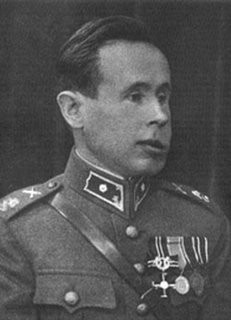
White Death: Simo Häyhä


        Deemed one of the greatest snipers of all time, Simo Häyhä represents the resilience of the Finns against their Soviet adversaries during the Winter War coinciding with World War II. Born in the small town of Rautajärvi in 1905, Simo tasted Soviet oppression at an early age due to the close proximity to the Russian border. Häyhä enjoyed the rugged landscape of rural Finland and swiftly developed as a farmer and skilled hunter known for his marksmanship. This solitary lifestyle enhanced his prowess with weaponry, an aptitude proven vital during the oncoming Winter War.
   
In 1925, a seventeen year old Häyhä joined the Finnish Army for a year of mandatory service and achieved the rank of corporal. Eventually Simo Häyhä joined the Suojelskunta (Finnish Civil Guard) similar to the National Guard of the United States prior to being entangled in the Winter War under the 6th Company’s banner. Simo responded to the aid of his country when the USSR invaded in November, three months after the eruption of WWII in 1939. While drifting through the tundra, Simo concealed himself by wearing white camouflage and refused to use a scope for he noted that the sun would reflect off the glass and give his position away. Another innovation he utilized was to put snow in his mouth in order to deny a foggy exhalation from escaping his lips. He took every precaution to avoid tipping off Russian counter-snipers of his location; soldiers bent on deposing their most feared adversary whom they dubbed “White Death.” Such a title was legitimized by his impressive five hundred and five head count. Using a Mosin-Nagant rifle which suited his short stature, Häyhä achieved the highest recorded number of confirmed sniper kills in any major war.
(An account of Simo Häyhä's background & military experience)

       A tactical professional, Simo’s credited with two hundred deaths by way of a sub-machine gun in addition to his aforementioned glory. During the most brutal days of the Winter War, Simo’s company secured the demise of Soviet expansion. Defending the Kollaa region was nothing short of a miracle as exposed by the massive loss the Soviet Army suffered at the hands of Finns refusing to comply with communist invaders. "The Miracle of Kollaa" proved to be the epitome of the Finnish chant “sisu” which translates to “guts” or “fortitude” in which the Simo’s 34th Regiment, nobly clashed against twelve Soviet divisions which equated 160,000 men as opposed to the single Finnish unit. Striking fear into the hearts of the advancing Red Army, Simo took solace in the closely shrouded timber while forced to deflect artillery units specifically deployed to exterminate their lone, elusive threat. Despite invisibly stalking Soviets in temperatures as low as –40 °C, a Russian soldier struck his mark on March 6, 1940. The bullet exploded into Häyhä’s jaw, blowing away half of his face and yet survived. Although successfully retrieved from the battlefield, Simo slipped into a coma until he regained consciousness March 13, the very day the war ended.
   
After his recovery, Simo advanced to the rank of second lieutenant, a rapid promotional feat nonexistent in the Finnish military. Offering a transfixing quote, Simo explained his regret by stating that “I only did my duty, and what I was told to do, as well as I could.” Permanently disfigured, the humble man soared as a national hero. In his later years, the outdoors man occupied his retirement by hunting moose, breeding dogs and responding to interviews related to his wartime exploits. Häyhä embodies the spirit of Finland; having played a pivotal role through which his accomplishments contributed to preserving Finnish sovereignty. The great sniper and Finnish warrior encapsulated the strength of a nation reflected by his valiant service and calm resolve.


___________________________________________________________________________

Suggested Reading:
"Simo Häyhä The White Death - World's Greatest Sniper." http://www.mosinnagant.net/finland/simohayha.asp (accessed January 27, 2014).

"The Incredible Story of Finnish Sniper Simo Hayha.” http://www.simohayha.com/ (accessed January 27, 2014).

“Finland at War, 1939-45 Volume 141 of Elite series” http://books.google.com/books?id=p58vtOKyVy8C (accessed January 27, 2014).

“Frozen Hell: The Russo-Finnish Winter War of 1939/40.” http://books.google.com/books?id=yXsLNVaDfcoC&lpg=PP1&dq=Trotter, William R. Frozen Hell: The Russo-Finnish Winter War of 1939/40.&pg=PP1 (accessed January 27, 2014)


“The Sniper Simo Hayha,” http://www.amazon.com/Sniper-Simo-Hayha-Tapio-Sarrelainen/dp/9525026744/ref=cm_cr_pr_pb_t (accessed January 27, 2014).